Advanced Analysis
Step 08 / 08기본적인 scRNA-seq 분석이 끝난 뒤에는, 연구 질문에 따라 doublet detection, cell cycle scoring, CNV inference, trajectory / pseudotime, cell-cell communication 같은 고급 분석으로 확장할 수 있습니다.
A) Advanced analysis란?
- 기본 workflow(QC → normalization → clustering → annotation)는 scRNA-seq 분석의 중심입니다.
- 하지만 실제 연구에서는 그 이후에 더 구체적인 biological question을 다루기 위해 추가 분석이 필요합니다.
- 이 단계의 목적은 모든 고급 기법을 깊게 설명하는 것이 아니라, 어떤 분석이 가능한지 큰 그림을 이해하는 것입니다.
핵심 포인트
- Advanced analysis는 “정해진 정답 루틴”이 아니라, 연구 질문 중심으로 선택하는 단계입니다.
- 분석을 추가할수록 해석 가능성은 넓어지지만, 과도한 해석은 피해야 합니다.
B) Doublet Detection
doublet은 하나의 barcode에 두 개 이상의 세포가 함께 들어간 경우입니다. QC에서 일부 의심할 수 있지만, 보다 정교하게는 전용 도구를 사용합니다.
library(DoubletFinder)
# 예시 workflow (Seurat object 기반)
sweep.res <- paramSweep_v3(obj, PCs = 1:20, sct = FALSE)
sweep.stats <- summarizeSweep(sweep.res, GT = FALSE)
bcmvn <- find.pK(sweep.stats)
# 적절한 pK 선택 후
obj <- doubletFinder_v3(
obj,
PCs = 1:20,
pN = 0.25,
pK = 0.09,
nExp = 200,
reuse.pANN = FALSE,
sct = FALSE
)
- doublet 후보는 높은 nFeature_RNA, 높은 nCount_RNA를 보이는 경우가 많습니다.
- 그러나 computational detection 결과도 완벽하지 않으므로, marker pattern과 함께 해석해야 합니다.
C) Cell Cycle Scoring
세포 주기(cell cycle)는 clustering과 DEG 해석에 영향을 줄 수 있는 주요 biological confounder 중 하나입니다.
s.genes <- cc.genes$s.genes
g2m.genes <- cc.genes$g2m.genes
obj <- CellCycleScoring(
obj,
s.features = s.genes,
g2m.features = g2m.genes,
set.ident = FALSE
)
head(obj@meta.data[, c("S.Score", "G2M.Score", "Phase")])
필요에 따라 cell cycle effect를 regression에 포함시킬 수도 있습니다.
obj <- ScaleData(obj, vars.to.regress = c("S.Score", "G2M.Score"))
D) CNV Inference
종양 샘플에서는 malignant cell을 추정하기 위해 copy number variation(CNV) 패턴을 inference하는 경우가 많습니다. 대표적으로 inferCNV가 많이 사용됩니다.
library(infercnv)
infercnv_obj <- CreateInfercnvObject(
raw_counts_matrix = counts_matrix,
annotations_file = "cell_annotations.txt",
delim = "\t",
gene_order_file = "gene_order.txt",
ref_group_names = c("normal")
)
infercnv_obj <- infercnv::run(
infercnv_obj,
cutoff = 0.1,
out_dir = "infercnv_output",
cluster_by_groups = TRUE,
denoise = TRUE,
HMM = TRUE
)
- CNV inference는 특히 종양 vs 정상 비교에서 유용합니다.
- 단, reference population의 설정과 tissue context가 매우 중요합니다.
E) Trajectory / Pseudotime
세포가 연속적인 상태 변화를 겪는 경우, cluster보다는 trajectory 또는 pseudotime 관점이 더 적절할 수 있습니다.
library(monocle3)
cds <- as.cell_data_set(obj)
cds <- cluster_cells(cds)
cds <- learn_graph(cds)
cds <- order_cells(cds)
plot_cells(cds, color_cells_by = "pseudotime")
pseudotime은 “진짜 시간”이 아니라, 발현 변화의 연속성을 기반으로 추정한 상대적 순서입니다.
F) RNA Velocity
spliced / unspliced transcript 정보를 이용하면 세포 상태 변화의 방향성을 추정할 수 있습니다. 보통 scVelo 또는 velocyto 기반 분석이 사용됩니다.
# Python ecosystem에서 주로 수행
# scVelo 예시 개념
import scvelo as scv
scv.pp.filter_and_normalize(adata)
scv.pp.moments(adata)
scv.tl.velocity(adata)
scv.tl.velocity_graph(adata)
scv.pl.velocity_embedding_stream(adata, basis='umap')
G) Cell-Cell Communication
서로 다른 세포 집단 간 ligand-receptor 상호작용을 추정하여, 세포 간 communication network를 해석할 수 있습니다.
library(CellChat)
cellchat <- createCellChat(object = obj, group.by = "celltype")
cellchat <- addMeta(cellchat, meta = obj@meta.data)
cellchat <- setIdent(cellchat, ident.use = "celltype")
cellchat <- subsetData(cellchat)
cellchat <- identifyOverExpressedGenes(cellchat)
cellchat <- identifyOverExpressedInteractions(cellchat)
cellchat <- computeCommunProb(cellchat)
cellchat <- computeCommunProbPathway(cellchat)
cellchat <- aggregateNet(cellchat)
- 대표 도구로 CellChat, CellPhoneDB, NicheNet 등이 있습니다.
- 결과는 “예측된 상호작용”이므로, 실험적 검증이 중요합니다.
H) Regulon / TF network
전사인자(transcription factor) 네트워크를 추정하여 세포 상태를 조절하는 핵심 regulator를 탐색할 수 있습니다. 대표적으로 SCENIC이 사용됩니다.
# SCENIC workflow는 보통 pySCENIC 또는 R SCENIC 사용
# 개념적 단계:
# 1. co-expression network 구성
# 2. motif enrichment로 regulon 정의
# 3. 각 cell에서 regulon activity score 계산
I) 어떤 분석을 선택할까?
| 연구 질문 | 적합한 고급 분석 |
|---|---|
| 이상한 cluster가 doublet인지 궁금하다 | DoubletFinder, Scrublet |
| cell cycle이 cluster를 흔드는 것 같다 | CellCycleScoring, regression |
| 종양세포를 정상세포와 구분하고 싶다 | inferCNV, CopyKAT |
| 분화 또는 상태 전이 과정을 보고 싶다 | Monocle3, Slingshot, scVelo |
| 세포 간 상호작용을 보고 싶다 | CellChat, CellPhoneDB, NicheNet |
| 핵심 전사인자를 찾고 싶다 | SCENIC, pySCENIC |
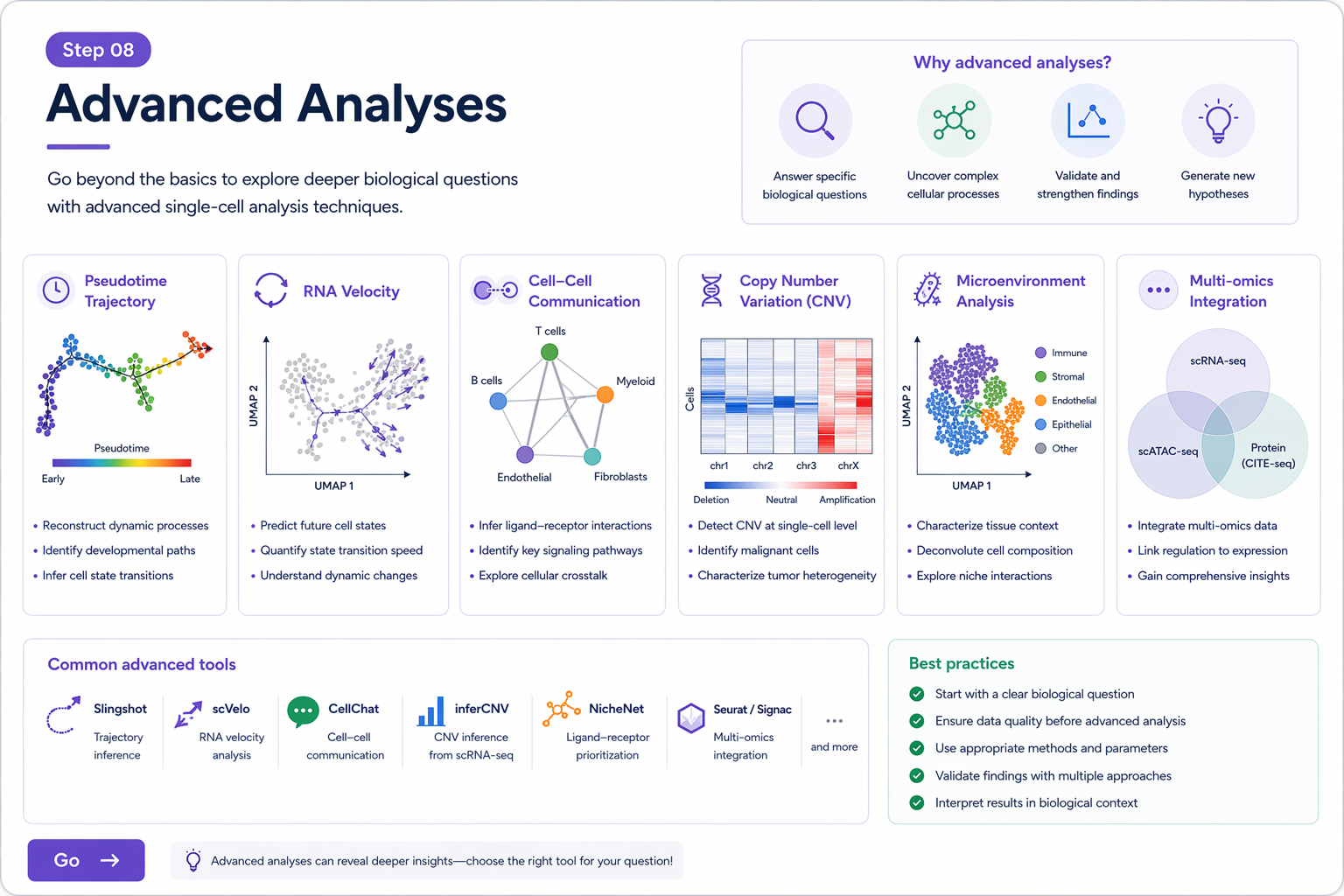
기본 분석 이후에는 연구 질문에 따라 doublet, cell cycle, CNV, trajectory, communication 등의 고급 분석으로 확장할 수 있습니다.
J) 해석 시 주의점
- 고급 분석 결과는 대부분 “예측” 또는 “추정”의 성격을 가집니다.
- 따라서 지나친 단정 대신, 기존 생물학 지식과 실험적 검증 가능성을 함께 고려해야 합니다.
- 기본 QC/annotation이 불안정한 상태에서 고급 분석을 추가하면 결과 해석이 더 왜곡될 수 있습니다.
- 항상 기본 분석이 충분히 타당한지 먼저 확인한 뒤 advanced analysis로 넘어가는 것이 좋습니다.
실전 팁
- 모든 분석을 다 할 필요는 없습니다. 연구 질문에 맞는 것만 선택하세요.
- 고급 분석일수록 입력 데이터 quality와 annotation quality가 더 중요합니다.
- 가능하면 하나의 결과만 믿지 말고, 서로 다른 방법이나 biological evidence로 교차검증하세요.
K) 전체 과정 요약
Step 01. Introduction + Server
Step 02. QC and Filtering
Step 03. Normalization and Feature Selection
Step 04. Integration and Batch Correction
Step 05. Dimensional Reduction and Clustering
Step 06. Cell Type Annotation
Step 07. DEG and Pathway Analysis
Step 08. Advanced Analysis
- Advanced analysis는 기본 workflow 이후 연구 질문에 따라 선택적으로 수행하는 확장 분석입니다.
- Doublet, cell cycle, CNV, pseudotime, communication, regulon 분석이 대표적입니다.
- 이들 결과는 대부분 추정 기반이므로, 기본 분석의 안정성과 biological interpretation이 매우 중요합니다.
- 가장 좋은 분석은 “많이 하는 분석”이 아니라, 연구 질문에 가장 잘 맞는 분석입니다.